
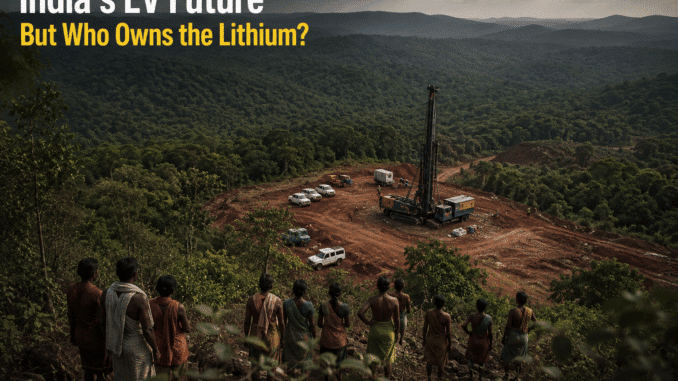
(A SanvaadGarh Investigation)
India wants an electric future.
From EV incentives to battery manufacturing deals, the country is racing to reduce dependence on imported fossil fuels and position itself as a global clean-energy power. But deep inside Chhattisgarh, a new resource battle is quietly taking shape, one that could define who truly benefits from India’s green transition.
The resource is lithium.
And the question is becoming impossible to ignore:
Who will own the wealth beneath Chhattisgarh’s soil?
The New Gold Rush
Recent geological findings in the Korba-Katghora belt have triggered interest from some of India’s biggest industrial players – including Coal India Limited, Vedanta Limited, and Adani Group.
Lithium is critical for:
- Electric vehicle batteries
- Grid-scale energy storage
- Smartphones and electronics
- India’s broader renewable energy ambitions
Globally, lithium is often called “white gold.”
And Chhattisgarh may soon become one of India’s most contested mineral frontiers.
A Green Transition Built on Old Extraction Models?
On paper, lithium represents progress, cleaner mobility, lower emissions, and energy independence.
But on the ground, communities fear a familiar pattern:
Exploration first. Consent later.
Many of the identified mineral zones overlap with forested regions and tribal belts already affected by decades of coal mining and industrial expansion. Residents who witnessed displacement during coal projects now fear another wave of land acquisition, this time in the name of “green energy.”
The irony is sharp:
India’s clean-energy future may still come at the cost of vulnerable communities.
The Missing Conversation: Who Gets a Say?
Mining rights discussions are accelerating.
Public consultation is not.
Experts warn that India risks repeating the mistakes of coal expansion:
- Weak local consultation
- Environmental clearances rushed under “national interest”
- Long-term ecological damage underestimated
- Economic benefits concentrated elsewhere
Lithium extraction can also be water-intensive and environmentally disruptive if poorly regulated, especially in ecologically sensitive zones.
Yet public debate around lithium mining remains minimal.
From Coal Belt to Battery Belt
Chhattisgarh has powered India for decades through coal.
But despite its mineral wealth, many mining districts still struggle with:
- poor healthcare
- unemployment
- pollution
- displacement
- weak rehabilitation systems
Now, the same regions are being projected as pillars of India’s EV revolution.
But unless governance changes, critics argue the transition may simply replace one extraction economy with another.
Coal powered India.
Will lithium repeat the same story?
The Climate Contradiction
Lithium is central to the global climate transition.
But “green” industries are not automatically just industries.
If forests are cleared, groundwater depleted, and communities displaced without consent, then the environmental cost merely shifts location hidden beneath the branding of sustainability.
A clean-energy future cannot be built on invisible sacrifice zones.
The Question India Must Answer
As corporations line up for strategic minerals and governments push EV targets, one reality remains unresolved:
Will Chhattisgarh finally benefit from the wealth beneath its land or once again bear the burden while others profit from the transition?
Because this time, the resource may be cleaner.
But the politics around it look painfully familiar.


Be the first to comment