
A SanvaadGarh Investigation | Korba, Chhattisgarh | February 23, 2026
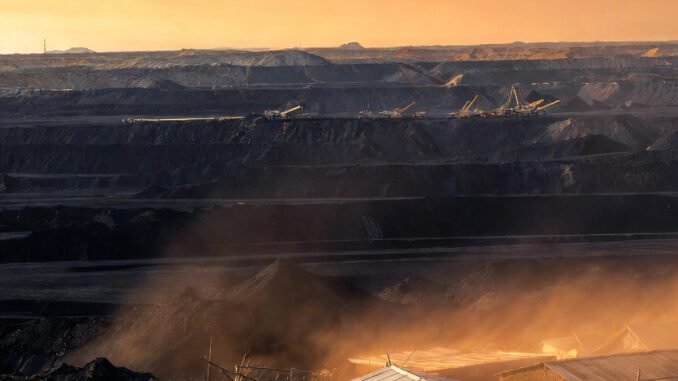
India stands on the cusp of a global record. Coal India’s Gevra mine in Korba, Chhattisgarh, already the country’s largest opencast operation is targeting 63 million tonnes of annual production in FY 2026–27, which would make it the world’s highest-output single coal mine, surpassing current leaders like the US Black Thunder Mine.
For New Delhi and Coal India, it is proof of energy security and industrial strength. For the communities living around Gevra, it is dust that never settles, villages that disappear, health that deteriorates, and promises that rarely arrive.
A Global Record Built on Local Loss
- Gevra is already producing around 56–60 million tonnes annually (recent FY figures).
- With environmental clearance secured for 70 MT capacity, the push to 63 MT in 2026–27 would place it ahead of existing global giants.
- The mine complex spans thousands of hectares, swallowing forest, farmland, and entire hamlets over decades.
Villagers wake to coal dust coating rooftops, crops, and water sources. Coughing is routine. Skin infections and breathing problems are common. Blasting vibrations crack homes and school walls — complaints that rarely leave district files.
Coal India calls it “collateral impact.” Residents call it everyday life.
Displacement Without Rehabilitation
Mining expansion has displaced thousands across Gevra, Dipka, and nearby areas. Many families received initial compensation years ago, often inadequate and eroded by inflation. Promised alternative livelihoods and permanent housing remain largely unfulfilled.
Displaced youth frequently end up as daily-wage workers in the same mining ecosystem that uprooted their families, an irony as brutal as it is predictable.
Coal extracted here powers distant cities. The villages supplying it often face electricity cuts and contaminated water.
Environmental Clearance vs Environmental Reality
On paper:
- Dust suppression systems exist.
- Water sprinkling is regular.
- Air quality is monitored.
On the ground:
- Independent studies and resident accounts describe routine breaches of PM2.5 and PM10 limits.
- Korba remains one of central India’s most polluted industrial clusters.
- Penalties stay negligible; accountability diffuse.
Dust clouds travel far beyond mine boundaries. Fly ash and overburden dumps contaminate soil and groundwater. Health surveys consistently link the area’s air and water quality to higher rates of respiratory diseases, silicosis, and other pollution-related illnesses.
The Climate Contradiction
India champions climate leadership on global stages and commits to net-zero by 2070. At home, it is doubling down on coal.
Gevra’s expansion highlights the tension:
- Coal remains essential for base-load power while renewables scale up.
- Yet the communities bearing the heaviest costs – polluted air, lost land, health burdens are rarely included in planning, compensation, or health safeguards.
Coal India maintains coal is necessary for development. It rarely explains why the price is paid almost entirely by those living beside the pits.
Who Pays the Real Cost?
The bill is not abstract.
It is paid by:
- Children growing up dependent on inhalers.
- Farmers whose fields no longer yield.
- Families relocated but never truly resettled.
- Forests lost forever, not “offset” on paper.
Gevra may soon top global coal charts. No global index measures the human and ecological cost of that achievement.
Until it does, the world’s biggest coal mine will remain not only an industrial milestone, but a moral question.
World’s biggest coal mine – yes.
But at whose expense?

Be the first to comment