
A SanvaadGarh Investigation
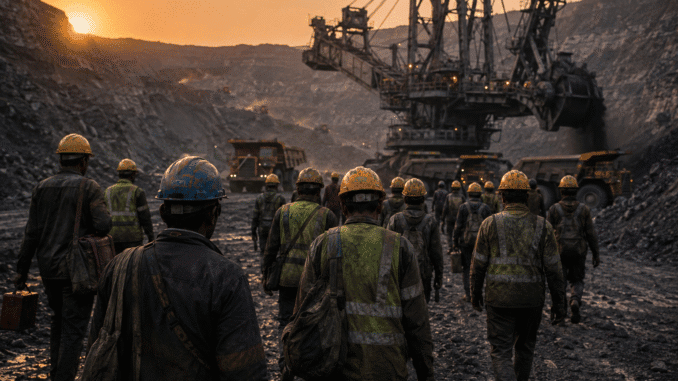
Every morning, before India’s lights switch on and its factories begin to hum, thousands of contract workers enter coal mines, thermal power plants and industrial facilities across Chhattisgarh.
They drill the coal. Repair the machinery. Load the trucks. Maintain the boilers.
Yet for many of them, the promise of stable employment remains just that, a promise.
While permanent employees often receive structured salaries, healthcare benefits and social security, contract workers frequently describe a different reality: uncertain employment, changing contractors, limited job security and constant anxiety about the next renewal.
They are the invisible workforce behind one of India’s most profitable industries.
The Backbone That Rarely Gets Recognition
From Korba’s coalfields to Raigarh’s industrial corridors, contract labour has become an integral part of mining and power operations.
Companies say outsourcing improves efficiency and allows specialized work to be completed more effectively.
Labour representatives argue that it has also created a workforce that is easier to replace and harder to organise.
For many workers, employment lasts only as long as the contractor’s agreement.
When contracts change, livelihoods can change overnight.
Working in High-Risk Environments
Mining and thermal power plants involve physically demanding and potentially hazardous work.
Workers often spend long hours around heavy machinery, coal dust, high temperatures and industrial equipment.
Safety standards are governed by law, and many companies state that they provide training and protective equipment. However, labour organisations have repeatedly called for stronger enforcement and greater oversight to ensure consistent implementation across contractors.
For contract workers, the concern is often not just safety on the job—but what happens after an injury or illness.
A Different Kind of Employment
For many families in industrial districts, a permanent company job once represented long-term financial security.
Today, contract employment has become increasingly common.
Workers say they face recurring concerns about:
- Short-term contracts
- Wage delays
- Limited social security awareness
- Uncertain career progression
- Dependence on contractors rather than direct employers
While experiences vary across companies and contractors, the shift towards contract labour has transformed the nature of industrial employment.
Powering India’s Growth
Coal remains central to India’s energy system.
Behind every tonne of coal extracted and every unit of electricity generated are thousands of workers whose names rarely appear in annual reports.
Their contribution is measured in production figures.
Their stories rarely are.
The Question That Matters
India’s industrial growth depends on people as much as resources.
As mining and power companies expand, an equally important question deserves attention:
Can economic growth truly be called inclusive if the people doing some of its hardest work continue to live with uncertainty?
The future of India’s energy sector will not be shaped only by technology or investment.
It will also be shaped by how it treats the workers who keep it running.


Be the first to comment