
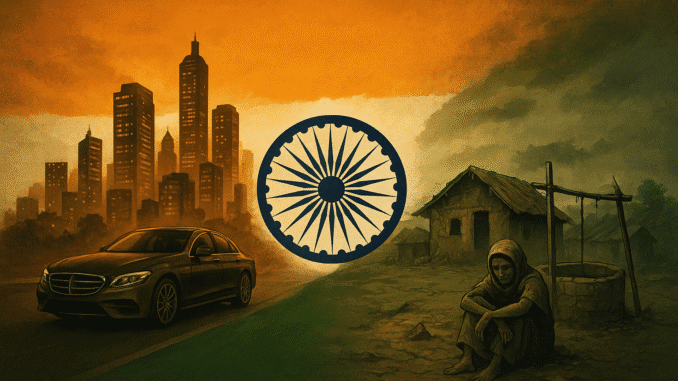
In the midnight hour of August 15, 1947, India promised itself freedom, not just from foreign rule, but from poverty, exploitation, and inequality.
Yet, nearly eight decades later, the economic map of India tells a story eerily similar to its colonial past.
The New Maharajas: Corporate Monopolies in Modern India
In 1947, India’s industrial wealth was concentrated in a handful of British companies and princely allies. Today, the top 10% of Indians hold 77% of the nation’s wealth, according to Oxfam India (2024). Two industrial conglomerates alone command sectors ranging from ports and power to telecom and retail.
While independence replaced the Union Jack with the tricolour, control over capital has simply changed hands.
Inequality by the Numbers
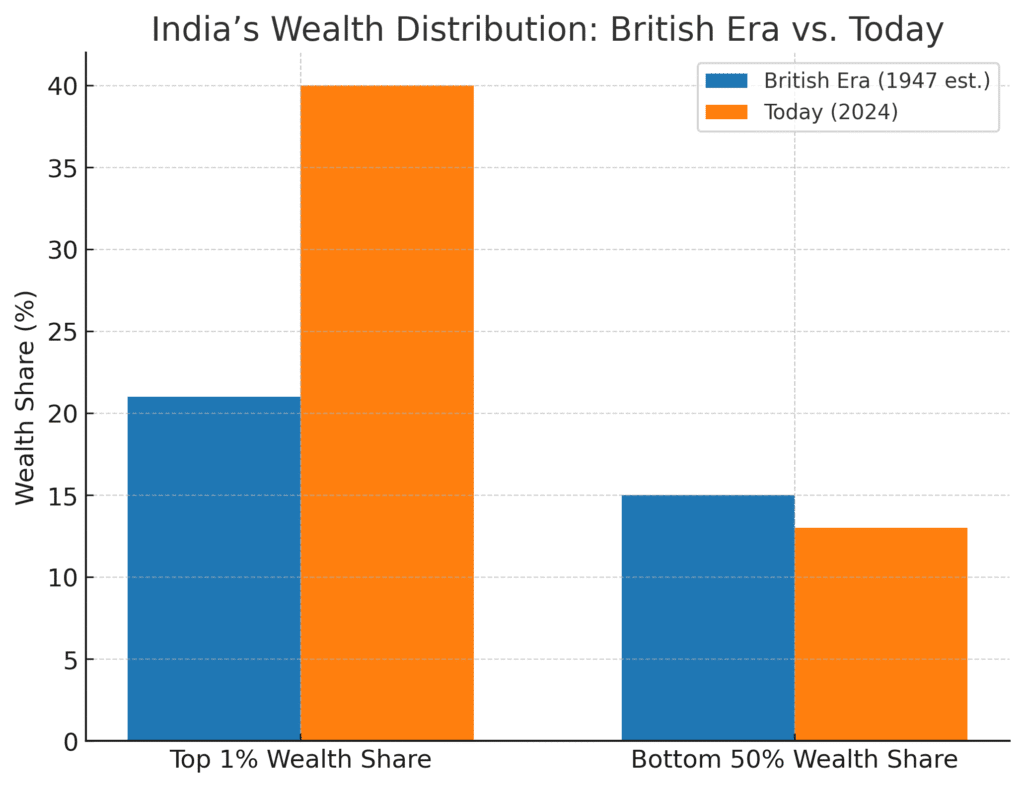
- Top 1% wealth share in 1947: Estimated at 20–22%
- Top 1% wealth share in 2024: Over 40%
- Bottom 50% wealth share today: Less than 13%
Even the British Raj’s economic policies, aimed at resource extraction, find echoes in the present-day rural-urban divide, agrarian distress, and wage stagnation for millions.
Economic Freedom: A Promise Deferred
The Constitution envisioned socialism-inspired equitable growth. Land reforms stalled, public sector industries weakened, and privatisation surged. From banking to coal mining, policy shifts have repeatedly favoured concentrated corporate power over broad-based wealth distribution.
Why This Matters on Independence Day
Independence without economic dignity is fragile. When 80 crore Indians depend on subsidised grain for survival while billionaires add millions to their fortunes daily, freedom becomes a hollow phrase.
This August 15, we must ask:
Is India free for all or just for the few who can afford it?




Be the first to comment