
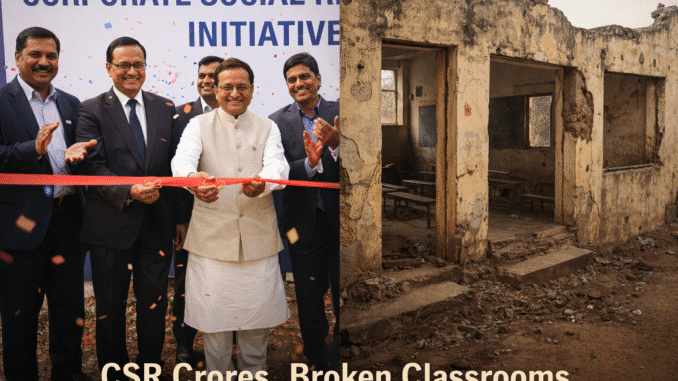
A SanvaadGarh Investigation | Korba & Raigarh, Chhattisgarh | March 03, 2026
Every year, mining and power companies in Chhattisgarh publish glossy CSR reports: crores allocated, schools adopted, hospitals upgraded, villages “empowered.”
Travel 5–10 km beyond the plant gates in Korba or Raigarh and the story quickly blurs.
If hundreds of crores are spent annually under Corporate Social Responsibility (CSR), why do so many villages still lack functioning health centres, safe drinking water, or staffed schools?
That is the question SanvaadGarh examined.
The CSR Promise
Under Section 135 of the Companies Act, large companies must spend 2% of average net profit on CSR. For coal, power, and mining giants in Chhattisgarh, this often means tens or hundreds of crores every year.
Typical listed activities include:
- Rural healthcare camps
- School infrastructure upgrades
- Drinking water projects
- Skill development centres
- Women empowerment programs
On paper, the impact looks substantial.
The Ground Reality
Villages around Korba’s coal belt and Raigarh’s industrial clusters tell a different story:
- School buildings constructed, but no regular teachers
- Health camps held once or twice, then discontinued
- Overhead water tanks installed, but pumps non-functional or pipelines dry
- Skill centres inaugurated with banners, later found locked or underused
Residents report that CSR activity often peaks just before major project expansions, environmental clearance hearings, or public protests. After approvals or clearances are secured, visibility drops sharply.
This recurring pattern raises a hard question:
Is CSR sustained development or strategic public-relations optics?
The Transparency Gap
CSR annual reports are usually broad-brush documents. They list spending categories and headline numbers but rarely provide:
- Village-wise or project-wise expenditure breakdown
- Independent third-party impact audits accessible to the public
- Measurable, long-term outcome data (e.g., before/after health indicators, school attendance rates, water quality tests)
Without granular, verifiable transparency, it is difficult to judge whether the money delivered real change or merely transactional goodwill.
Crores may be spent.
But was the spending transformative or temporary?
When CSR Replaces Accountability
CSR is voluntary corporate goodwill layered on top of business operations. It is not a substitute for:
- Effective pollution control
- Full rehabilitation of displaced families
- Long-term health monitoring for pollution-affected communities
- Environmental restoration of mined or ash-affected land
If a company pollutes air and groundwater but funds a one-off water purifier in a school or a health camp every few months – is that responsibility, or reputation management?
The Larger Question
Chhattisgarh hosts some of India’s largest mining, coal, and power projects.
It also bears some of the heaviest pollution and displacement burdens.
If CSR spending is roughly proportional to profit, then its impact should be visible, measurable, and undeniable in the communities closest to the operations.
Instead, in many locations, it remains largely symbolic.
CSR should not be charity.
It should be accountability in action.
Until spending is transparent, audited, and matched to lived reality on the ground, the question persists:
Are CSR crores changing lives or just annual reports?

Be the first to comment