
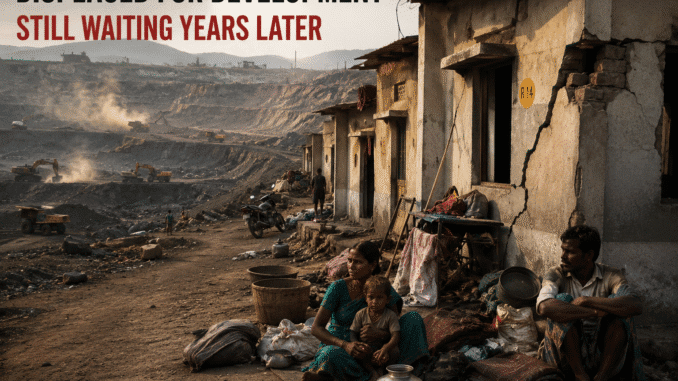
(A SanvaadGarh Investigation | Chhattisgarh)
In the coal belts of Chhattisgarh, displacement rarely arrives as a single moment.
It begins slowly.
A survey team visits the village.
Land gets marked.
Promises are made – jobs, compensation, rehabilitation, a “better future.”
Then the machines arrive.
Years later, many families displaced by mining expansion across Korba, Raigarh, and surrounding industrial zones say they are still waiting for what they were promised.
Waiting for permanent housing.
Waiting for employment.
Waiting for compensation disputes to be resolved.
Waiting, above all, for accountability.
Development Came. Stability Didn’t.
Across coal-producing regions, land acquisition for mines, ash ponds, railway corridors, and industrial infrastructure has transformed entire landscapes.
Official documents describe these projects as engines of national growth. But for many displaced families, development has felt deeply unequal.
Some now live in partially developed rehabilitation colonies with weak infrastructure, irregular water supply, and limited livelihood opportunities. Others say compensation money disappeared quickly, unable to replace farmland, social networks, or long-term security.
The land was permanent.
The compensation wasn’t.
The Promise of Jobs
One of the most common assurances during land acquisition is employment for affected families.
But many residents allege that jobs either never materialised, were outsourced to contractors, or went to only one member per household under restrictive conditions.
Younger generations now face a painful contradiction:
Their villages were cleared in the name of economic growth yet stable employment remains out of reach. Some families displaced by mining projects now survive through daily-wage labour near the very mines that replaced their homes.
Rehabilitation on Paper vs Reality on Ground
Mining companies and authorities often cite rehabilitation packages as evidence of responsible expansion.
On paper:
- housing plots allocated
- roads sanctioned
- schools proposed
- healthcare access improved
On the ground, many displaced communities describe incomplete implementation and long delays.
Residents in several rehabilitation areas say basic facilities remain inconsistent years after relocation. In some places, social structures built over generations fractured after communities were split across different resettlement zones.
Displacement did not just move homes.
It disrupted identity, livelihood, and belonging.
The Invisible Cost of Extraction
Coal powers cities, industries, and national growth targets. But the social cost of extraction rarely enters economic headlines.
There is no national dashboard measuring:
- psychological trauma from displacement
- long-term livelihood collapse
- intergenerational instability
- cultural loss in uprooted tribal communities
The result is a system where output is tracked meticulously while human consequences fade into administrative language.
Who Carries the Burden of Growth?
India’s energy ambitions continue to expand. So do mining corridors.
But in regions already carrying decades of extraction, displaced families are beginning to ask a sharper question:
If the country profits from the land beneath our feet, why are we still struggling to rebuild our lives above it?
Until rehabilitation becomes more than paperwork, displacement will remain one of India’s most underreported development crises.
And behind every mine expansion file lies another family still waiting.

Be the first to comment