
The SanvaadGarh Desk
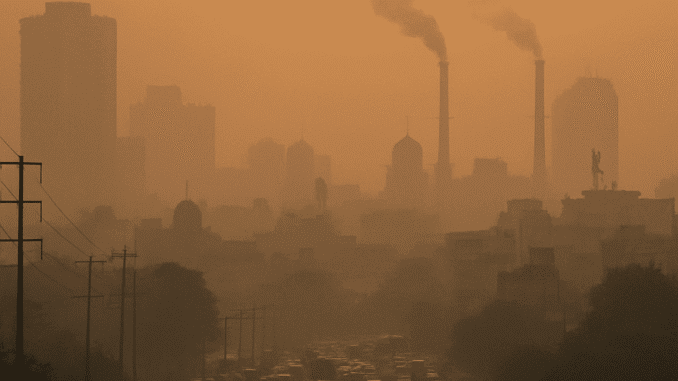
When the sun sets over Delhi, the skyline fades not into twilight but into a grey blur, a haze so dense it hides both stars and accountability. The air tastes of dust and exhaust, thick with the weight of everything the country has chosen to ignore.
Across India, this has become the new normal. From the industrial belts of Korba and Singrauli to the capital’s choked corridors, millions now breathe what scientists call “air unfit for human lungs.” But the true tragedy lies not in the smog itself, it lies in how the nation has learned to live with it.
In Korba, Chhattisgarh – one of India’s largest power-producing regions – fly ash from thermal plants drifts over fields, coating homes and crops. Locals say mornings begin with sweeping soot off courtyards before making tea. “It’s not fog,” one resident said, “it’s waste.” SanvaadGarh’s field review found six of eight villages near BALCO and NTPC facilities reporting chronic breathing disorders, yet emission fines remain unpaid and disposal ponds still overflow.
Further north in Singrauli, Madhya Pradesh, the air carries coal dust that never quite settles. “You stop looking for the stars,” a young teacher told us, “because you haven’t seen them in years.”
And in Delhi-NCR, the story replays every winter – school closures, bans, emergency meetings. But by the time the headlines fade, the smog remains.
According to the World Air Quality Report 2024, India ranked among the five most polluted countries on Earth, with over 60% of its population breathing air deemed hazardous by WHO standards. CPCB data shows nine out of ten industrial clusters operating above permissible PM2.5 levels, yet most have been granted “temporary compliance extensions.”
The government’s National Clean Air Programme (NCAP) promised a 30% reduction in particulate pollution by 2024. The reality: just 8% average improvement in major cities, with little progress in industrial zones. The reason, say experts, is clear – selective enforcement.
“Every winter we call it a crisis,” says Dr. Arvind Kumar, founder of the Lung Care Foundation.
“But it’s not a crisis anymore. It’s a chronic condition of our policies, our politics, and our priorities.”
What makes this crisis invisible is its slow violence. Unlike floods or earthquakes, air pollution doesn’t strike, it erodes. It creeps into lungs, schools, and fields; it dulls public outrage with repetition.
The apathy is bipartisan. Governments blame stubble-burning farmers, yet routinely dilute industrial emission norms in the name of “ease of doing business.” But as India chases growth, its people are quietly paying with their breath.
This October, as the haze thickens again, one question lingers through the smoke:
Will India ever treat clean air as a right or continue to live as if breathing itself is optional?
Read this also – Poison in the Air – Korba’s Silent Health Emergency


Be the first to comment